Unity Game Engine: How It Works and Why Game Studios Choose It
A practical look at what Unity offers developers, from cross-platform reach to pricing, so you know what you’re building on.
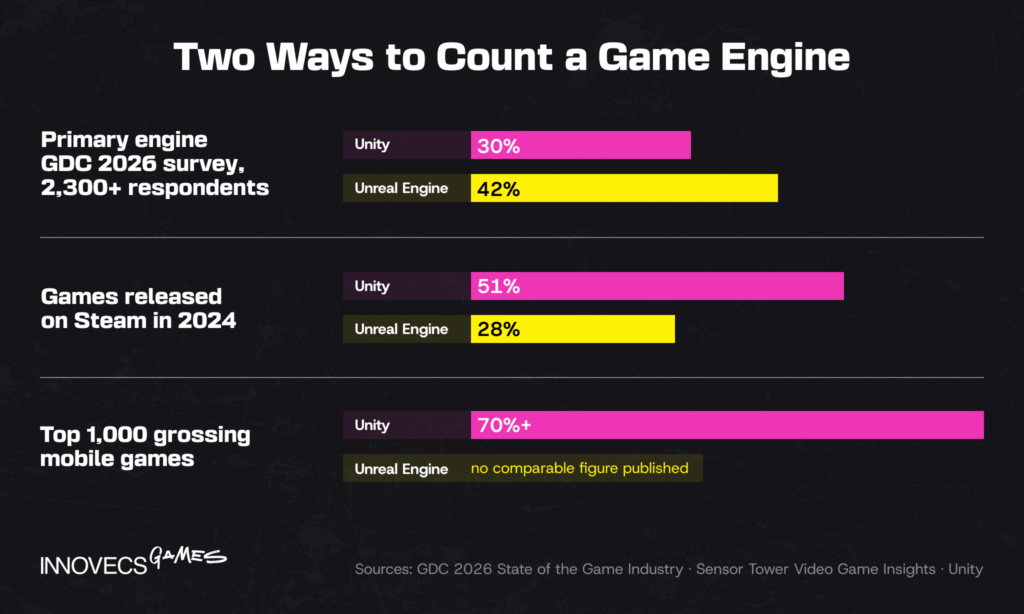
GDC has been asking developers which engine they use for longer than most current studios have existed. In the 2026 State of the Game Industry, more of them named Unreal than Unity for the first time: 42% against 30%, from over 2,300 responses. Half the trade press ran it as an obituary.
Then you look at what actually shipped, and the obituary gets awkward. Unity claims more than 70% of the top 1,000 mobile games. Analysts at Sensor Tower’s Video Game Insights counted Unity behind 51% of everything that launched on Steam in 2024, with Unreal on 28%. Inside that same GDC survey, 54% of people at established indie studios named Unity anyway. So Unreal wins the question about which engine you’d like to be seen holding, and Unity wins the download charts. Both results are real. Picking on the headline is how a studio ends up rebuilding a mobile pipeline in year two, and we’ve watched that happen more than once.
So: what is the Unity game engine actually good at in 2026, what does it cost now that the licensing has settled, and where does it fall down? Below are the five capabilities that keep studios on Unity, the current pricing tiers and revenue thresholds, and how Unity’s AI tooling has changed since Muse was retired. Also the cases where another engine is the better call.
What Is Unity in Game Development?
Strip the marketing away and Unity is two things bolted together. A real-time 3D engine handling rendering, physics, animation, audio, and input. An editor that pushes the result out to mobile, PC, console, WebGL, and XR. You write gameplay in C# scripting, arrange a scene in the Unity Editor, hit Play, and watch it run. No compile step, no launch wait. That loop is the actual product, and everything else Unity sells is an attempt to charge you for something adjacent to it.
The range of what people have built on it is the real argument. Niantic shipped Pokémon Go; Studio MDHR hand-inked Cuphead; Blizzard still runs Hearthstone on it; InnerSloth made Among Us for less than most publishers spend on a launch dinner. Nintendo put Super Mario Run on it, which says something about how far the trust extends. Unity’s made with Unity gallery and the #MadeWithUnity tag collect the rest, with the usual caveat that nobody posts the ones that died in soft launch.
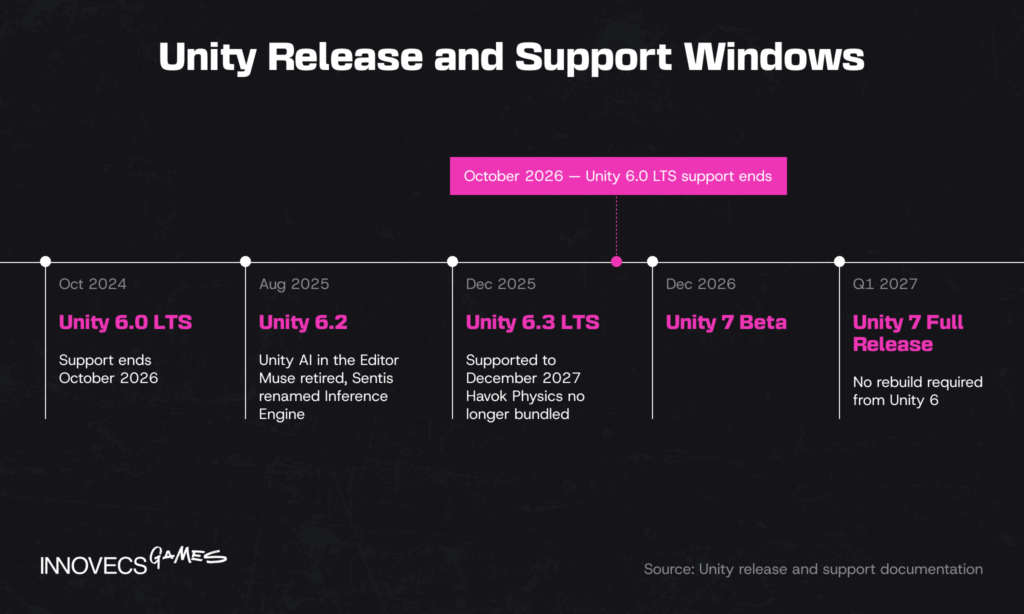
Production teams are on Unity 6.3 LTS, out since December 2025, with two years of support and a third year for Enterprise and Industry. The date worth writing down is October 2026, when 6.0 LTS support ends. If you’re running a live-service title on 6.0, that belongs in the risk register rather than in somebody’s memory. What makes 6.3 worth the upgrade argument is that Unity validated it against shipping games instead of test scenes and then published the results. ZA/UM cut TypeTree runtime memory in Disco Elysium by over 97%. Second Dinner got 99% on MARVEL SNAP. 10 Chambers took a 90-minute build of Den of Wolves down to 30. Build times are the least glamorous thing an engine vendor can fix and the one your team will actually thank you for.
What Makes Unity a Leading Game Engine?
Five things keep studios on Unity, and graphics isn’t one of them. Reach. Iteration speed. An asset ecosystem that shortens preproduction. A hiring pool that dwarfs every alternative. And a licence with no royalty attached to it. Somewhere along the way the Unity 3D game engine turned into a platform play whose reach extends well past the gaming realm, which is either impressive or a distraction depending on the week you catch us. Any game engine comparison that stops at rendering quality is measuring the wrong thing.
How Does Unity Support Cross-Platform Game Development?
Reach is why most studios land on Unity, and it isn’t close. One project targets over 20 platforms without a second codebase: phones, consoles, desktop, browsers, and the VR and AR headsets that keep arriving with a new SDK and leaving without warning.
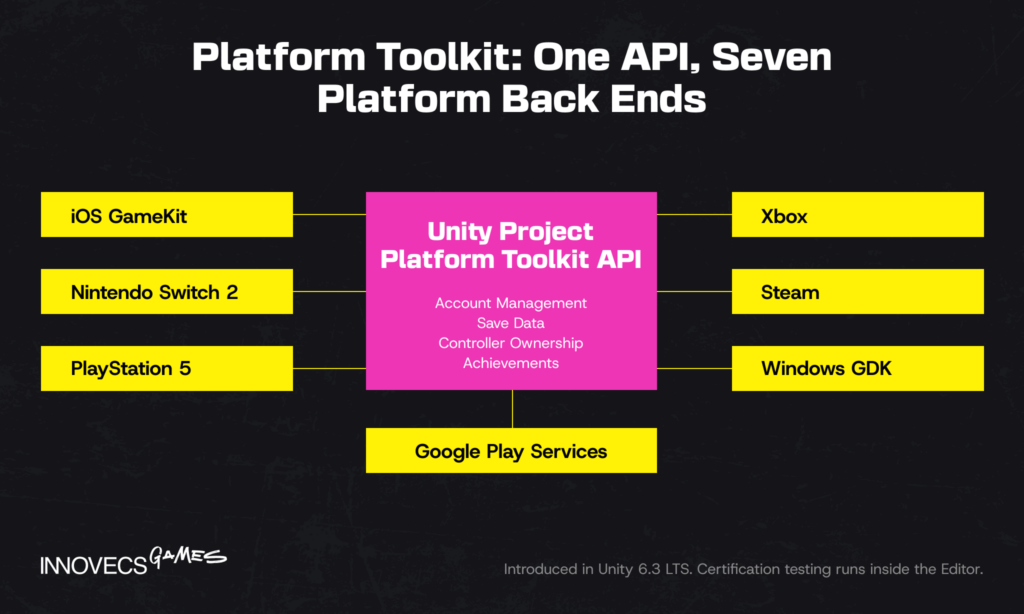
Mobile is where reach turns into money, and Unity 6.3 finally dealt with the tedious part. Platform Toolkit gives you a single API for account management, save data, controller ownership, and achievements across Google Play Services, iOS GameKit, Nintendo Switch 2, PlayStation 5, Xbox, Steam, and Windows GDK. Ship with the Unity game engine for Android and the Play Games sign-in flow stops being a port task; it becomes configuration. Certification testing moves into the Editor instead of a device farm, which hands back roughly the two weeks that always vanish before submission.
Now the part the marketing leaves out. Cross-platform means one codebase, not one build. Per-device texture budgets, per-store compliance, and a QA matrix that grows with every SKU all survive intact. Unity’s own 2026 Game Development Report has 38% of studios naming consistent experience across devices as their biggest cross-play obstacle, and every one of those studios had Unity’s tooling in hand when they said it.
The arithmetic still works, though. More platforms mean a bigger addressable market and better odds on revenue, which is the entire commercial case for cross-platform game development and a sturdier argument than any feature list.
Why Is Unity’s Interface Considered Developer-Friendly?
The editor is where Unity earns its reputation. Prototyping and playtesting need no setup phase, and the pre-built asset library means a designer can drop in character models, particle effects, and soundscapes before an engineer has finished reading the brief.
Drag-and-drop components and visual scripting let designers assemble mechanics, interactions, and UI without queueing for engineering time on every iteration. That helps the schedule far more than it helps the headcount, whatever the sales deck implies. Onboarding gets cheap for the same reason: Unity Learn runs free structured pathways, so a junior can be useful on a real task inside a fortnight.
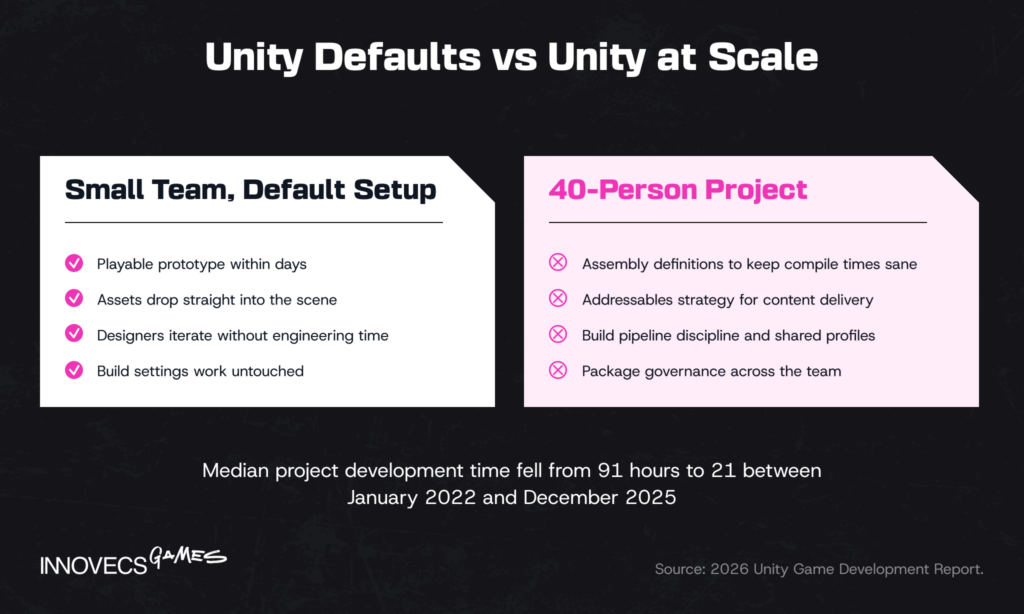
Unity put a number on the effect in its 2026 Game Development Report, drawn from proprietary data across nearly five million engine users: median project development time dropped from 91 hours to 21 between January 2022 and December 2025. Two-thirds of surveyed developers now finish prototyping inside three months. That has quietly rewritten what a greenlight meeting looks like. Teams try five ideas cheaply instead of betting the year on one, which is better for the medium and considerably harder on anyone who enjoyed being certain.
Where the friendly interface stops being friendly is scale. Put 40 people on one Unity project and somebody will spend real engineering weeks on assembly definitions, addressables, and build pipeline discipline, because the defaults assume a small team moving fast. Nobody puts that work on a roadmap. Everybody does it eventually.
How Good Are Unity’s Graphics and Visual Effects?
Two rendering pipeline options ship in the box. URP, the Universal Render Pipeline, goes wide across hardware. HDRP, the High Definition Render Pipeline, is for PC games and console builds at the top end. Artists get Shader Graph, VFX Graph, real-time lighting, and post-processing without ever touching engine source, and 6.3 added terrain shaders plus native SVG in UI Toolkit.
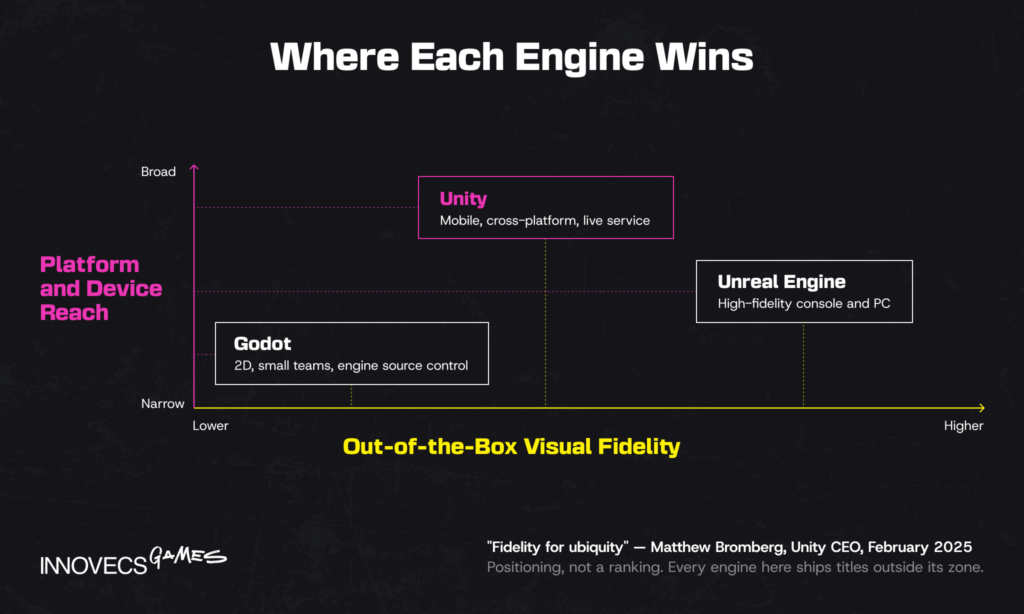
Here’s the honest read. If your pitch deck is built on photorealism, Unreal’s Nanite and Lumen get you further out of the box. That is a large part of why 59% of AA developers and 47% of AAA developers in the GDC survey now name Unreal as their primary engine. Unity’s strength is stylized art direction at a stable frame rate on hardware you don’t control. Cuphead and Monument Valley 3 are not Unity games because Unity was cheap.
Getting there is a technical art problem more than an engine problem. Shader authoring, lightmap budgets, and LOD strategy decide whether a Unity build looks handmade or looks like the URP default. Unity provides all the tools and technologies needed to achieve breathtaking visuals; the studios that get them are the ones with a game technical art discipline behind the pipeline. Our full Unity vs Unreal comparison goes deeper on where each engine’s rendering stack actually wins.
What Does the Unity Asset Store Offer Developers?
A million-odd listings sit on the Unity Asset Store: 3D models, textures, sound effects, AI behaviour systems, editor extensions, specialized scripts. For a prototype it’s the difference between a playable build in three weeks and one in three months. Anyone claiming they build all of it from scratch at that stage is either exaggerating or behind schedule.
Unity 6.3 added Core Standards on top, a signing and verification programme for third-party integrations, labelled in the store and in Package Manager. It tackles the store’s oldest failure mode: an abandoned plugin that breaks on the next Editor upgrade and takes a milestone with it. Verification helps. It doesn’t excuse you from reading the changelog before shipping a dependency, and any indie developer six plugins deep in a live title knows exactly how that story ends.
The collaborative half of the ecosystem is real too. Between the Asset Store and the wider Unity community, developers trade away problems that would each have cost a sprint, and the community has grown by orders of magnitude since Unity’s 2022 developer-count reporting. Publishing to the store also opens a secondary revenue line from tooling you built for yourself, which is how several of the best-known Unity editor extensions began: as somebody’s internal fix for something intolerable.
Where Is Unity Used Beyond Gaming?
Unity’s reach outside games is wider than most developers realize, and it turns up in industries you’d never associate with it. Architects walk clients through buildings that don’t exist yet, which turns out to be a far better sales tool than a static render ever was. Research on virtual tours credits them with higher client satisfaction, lower construction costs, and design collaboration that stays honest, mostly because it’s harder to argue with a space you can walk through.
For a games studio, the practical consequence of all this is a labour market. Unity skills transfer into automotive, simulation, training, and digital twins, which makes Unity engineers easier to find and equally easy to lose to an industrial client paying above games rates. Both halves of that are worth planning around. Unity’s own solutions catalogue shows how far the non-games side now reaches.
See What a Unity Development Team Can Build for You
Most studios don’t need to be convinced the Unity game engine works. They need the six weeks of ramp-up removed from the schedule. Tell us the gap and the milestone date, and we’ll scope a team that plugs into your existing pipeline.
Is the Unity Game Engine Free? Pricing and Licensing Explained
Yes, up to a revenue ceiling. Unity Personal costs nothing if your combined annual revenue and funding sit under $200,000, and since Unity 6 you can even switch off the splash screen, which developers had been asking about for roughly a decade. Cross that threshold and Pro becomes mandatory. Cross $25 million and Enterprise does.
The number that matters most here is the one Unity deleted. The Runtime Fee, announced in 2023 and met with the loudest backlash in the engine’s history, was cancelled on September 12, 2024 and never applied to a single shipped game. In its place came predictable annual adjustments, the first of which landed on January 12, 2026 as a 5% rise on Pro and Enterprise. Boring is the correct outcome for a licensing model, and it took an industry-wide revolt to get there.
The uncomfortable part deserves saying out loud, because an engine choice commits you to a company and not only to a piece of software. Unity has been unstable since 2023. John Riccitiello resigned that October in the wake of the Runtime Fee. Unity terminated its Weta FX agreement and cut 265 roles in November. January 2024 brought a company reset that removed roughly 1,800 people, a quarter of the workforce. Matthew Bromberg took over as CEO in May 2024, and further cuts followed in February 2025, taking the whole Unity Behavior team with them. None of that has damaged the engine, and 6.3 is the steadiest release in years. But a live-service title locked to one version until 2028 is a bet on the vendor as much as on the runtime, and that belongs in the same risk register as the LTS date.
| Plan | Who it’s required for | 2026 price | What you get |
|---|---|---|---|
| Unity Personal | Under $200K annual revenue and funding | Free | Full engine, optional splash screen, Unity Cloud version control and Asset Manager, Cloud Diagnostics |
| Unity Pro | Over $200K in revenue or funding | $2,310/yr per seat prepaid, or $210/mo | Console and Apple Vision Pro publishing, priority support, premium support add-ons |
| Unity Enterprise | Over $25M annual revenue and funding | Custom, minimum commitment may apply | Premium technical support, Unity source code access, three years of extended LTS |
Source: Unity pricing updates, effective January 12, 2026. Amounts in USD and may vary by region.
Read the middle column before the price column. The tier is not a choice you make on features; it’s assigned by your revenue and funding, and a funding round can move you a tier before you’ve shipped anything.
Two more line items belong in any budget that intends to survive. Console publishing requires Pro, so a Switch 2 or PS5 SKU means seats for everyone touching that build and not just the platform engineer. Havok Physics also stopped being included with Pro, Enterprise, and Industry as of Unity 6.3 LTS, which leaves projects that depend on it choosing between staying on 6.0 and licensing directly from Microsoft’s Havok team. Teams have already been caught out by that one.
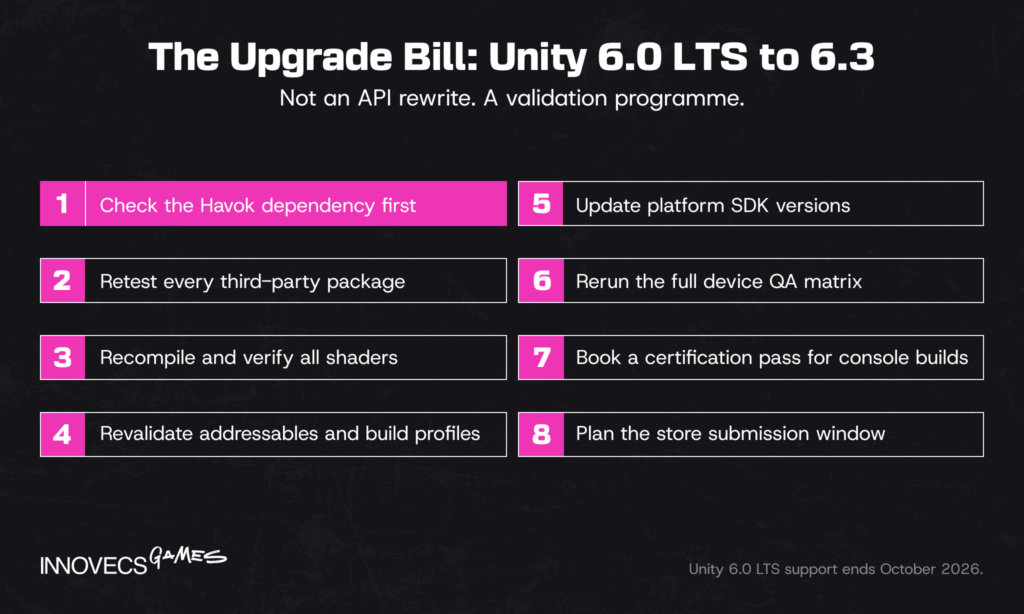
There’s a third cost that never appears on a licence line, which is the upgrade itself. Moving from 6.0 LTS to 6.3 before support ends in October 2026 isn’t an API rewrite; Unity kept the Unity 6 surface stable across minor versions deliberately. What you pay for is validation. Every third-party package needs retesting, shaders recompile, addressables and build profiles want a pass, platform SDKs shift underneath you, and a live console title needs a full certification run before any of it reaches players. Budget it as a sprint with a QA tail behind it. Teams that treat it as a version bump in the last month before October find exactly the same work waiting, just with a submission window attached to it. Check the Havok dependency first, because that’s the one hard incompatibility in the set.
Against the alternatives, the shape of the decision is straightforward.
| Engine | Free tier | Paid model | Royalty | Best fit |
|---|---|---|---|---|
| Unity | Under $200K revenue and funding | $2,310/yr per seat (Pro) | None | Mobile, cross-platform, live service, mid-size 3D |
| Unreal Engine | Under $1M lifetime gross revenue | $1,850/yr per seat for non-games use | 5% above $1M | High-fidelity console and PC, virtual production |
| Godot | Unlimited, MIT licensed | None | None | 2D, small teams, projects that need engine source control |
The trade-off column is the one people skip and then rediscover in month four. Unity’s seat cost is fixed and predictable, which finance likes and which hurts most when your team is large and your revenue is small. Unreal’s royalty costs nothing until you succeed, then scales with success forever. Neither model is generous; they just fail in different directions.
Unity’s own CEO has told you where the ceiling sits, which saves everyone a discovery call. Matthew Bromberg set the company’s direction as “fidelity for ubiquity” in an internal note reported in February 2025: Unity chases the widest possible reach across platforms and devices rather than the best possible pixels. That’s a product strategy stated plainly, not an apology, and it means some projects belong somewhere else.
Skip Unity if the pitch is a photoreal open world running at 4K on console. Nanite and Lumen have no direct equivalent here, and closing that gap is a technical art programme with a headcount attached rather than a setting you enable. Skip it if the simulation is the game and you need ECS from day one, because DOTS carries a real learning curve and most of the Asset Store still assumes MonoBehaviour underneath. Think hard if your senior hires are console specialists: 59% of AA and 47% of AAA developers in the GDC survey work in Unreal, and a talent pool is not something you can license around. And if owning the engine source outright is a genuine requirement, Godot is the honest answer rather than a long negotiation over Unity Enterprise.
What Do Unity’s Paid Plans Add?
Console publishing is Pro’s headline entitlement, and for most studios that settles the question on its own. Priority customer service and paid support add-ons come with it, and both stop being abstract the moment a platform holder rejects a submission and your patch window is measured in days. Enterprise layers on premium technical support, Unity source code access, and a third year of extended LTS, which is the clause that matters when a live-service title is locked to one version for years. From March 2026, every tier also gets unlimited cloud seats for Unity Version Control and 25 GB of free storage, up from 5. Free tiers getting more generous while paid tiers get 5% dearer is a fair one-line summary of where Unity’s commercial thinking currently sits.
How Is Unity Evolving With AI?
Check the dateline on anything you’ve read about Unity and AI, because most of it is already wrong. Those tools announced as Unity Muse and Unity Sentis don’t exist under those names anymore. Muse got retired outright. Sentis kept its job and lost its name, and as the Inference Engine it still runs neural networks locally in the Editor or in the shipped runtime, letting a model drive in-game behaviour with no server round trip.
Muse’s replacement turned up with Unity 6.2 in August 2025, wrapped in the name Unity AI and built into the Editor rather than sold as a $30-a-month side purchase. Assistant fields technical questions and writes code with your project as context. Generators cover sprites, textures, materials, sound, and animation. Both burn Unity Points, a credit system bundled with paid subscriptions or bought on its own, so AI usage has quietly become a metered line item on somebody’s budget.
Unity 7 pushes further and gives coding agents a seat at the table. Announced at Unite Seoul in July 2026, it ships a CLI, a public API, and a free MCP server wiring external agents straight into Unity, on top of a CoreCLR core with near-instant Play Mode and shader builds up to 90% faster. None of it, Unity says, needs a rebuild from Unity 6. Beta opens in December 2026, full release lands in Q1 2027, and anyone who has survived an engine migration knows that “no breaking changes” is a promise best verified on a branch.
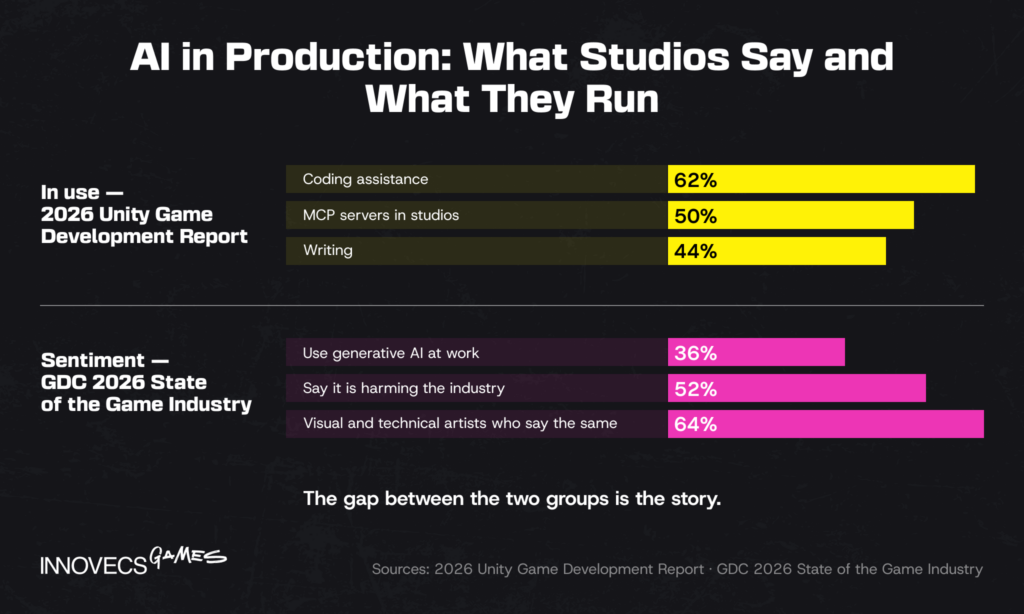
Then there’s how the industry actually feels about all this. GDC’s 2026 survey has 52% of professionals calling generative AI harmful, up from 30% a year earlier and 18% the year before. Visual and technical artists lead the opposition at 64%. And 36% use the tools anyway. Unity’s report puts the back-end adoption at 62% for coding assistance and 44% for writing, with half of surveyed studios now running MCP servers. Somewhere in that gap between what teams say and what they do is where AI-assisted development really sits in 2026: procedural tools and automated QA slide in without comment, art generation starts a fight in the Slack channel. Our position, for what it’s worth, is that the tooling is landing in exactly the parts of production nobody wanted to do by hand, and the studios adopting it quietly are collecting most of the benefit and none of the argument.
How Innovecs Games Helps You Build With Unity
We’ve been putting Unity teams into live productions across mobile, casual, and mid-core since long before Unity 6 existed. What clients ask for is rarely a full build. It’s a gap with a date on it: a technical artist for the URP pass, a gameplay engineer through to milestone three, a QA lead who has been through certification before. Our Unity game development services cover that shape of engagement as readily as full-cycle work.
Ramp-up is the argument for a dedicated Unity team, not the rate. Someone who already knows addressables, build profiles, and the console certification checklist contributes in week one rather than week six, and carries part of the milestone instead of closing tickets. Outsourcing this way costs more per month than assembling something yourself out of freelancers. It costs a great deal less than a missed submission window.
If you’d rather build the capability in-house, we’ve written up what that market looks like and what it costs to hire Unity developers directly. We’d rather you make the right call than the one that ends with us.
FAQ
What is the Unity game engine?
Think of it as two products in one box. The engine takes care of rendering, physics, animation, audio, and input; the editor draws your scene live, so a change shows up without a rebuild. Gameplay gets written in C#, and one project deploys to more than 20 platforms. Unity Technologies has been shipping it since 2005, and 6.3 LTS is what production teams run today.
Is Unity free to use for game development?
Free, right up until you’re doing well enough to notice. Unity Personal costs nothing below $200,000 in combined annual revenue and funding, takes no royalty, claims no revenue share, and since Unity 6 lets you switch off the splash screen. Past that line Pro becomes mandatory at $2,310 per seat per year. Past $25 million it’s Enterprise on custom terms. Note that the threshold counts funding as well as revenue, which catches out more studios than you’d think.
What is Unity used for?
Games, overwhelmingly, across mobile, PC, console, web, and XR, from hyper-casual through mid-core live service. Then there’s everything else: architects run walkthroughs on it, carmakers build configurators and driving simulation, factories train staff, film crews previsualize shots, retailers show products. Real-time 3D rendered on demand rather than pre-baked is the thread running through all of it. That non-games business now competes with games studios for the same engineers, which feels considerably less charming when you’re the one hiring.
How does Unity compare to Unreal Engine?
Depends what you’re optimizing for, and anybody who answers that faster is selling something. Unreal takes visual fidelity out of the box, and GDC’s 2026 survey has it ahead as a primary engine, 42% to Unity’s 30%. Unity takes mobile performance, iteration speed, the asset ecosystem, and licensing you can forecast without a lawyer. The money works differently too, with Unity billing per seat while Epic takes 5% above $1 million gross. Photorealistic console and PC work leans Unreal; anything headed for phones or juggling many SKUs leans Unity.
What programming language does Unity use?
C#, and it has been ever since UnityScript was put out of its misery. Compilation runs through Unity’s own backends, IL2CPP included, for platforms like iOS and consoles that demand ahead-of-time builds. Designers can stay inside visual scripting for logic, though most production teams keep anything gameplay-critical in actual code. Native plugins let you drop down into C++ for low-level or performance-critical work, but that’s an exception you plan for rather than a workflow you live in.
Can Unity be used for mobile game development?
Mobile is where Unity is strongest, and it isn’t a close race. Over 70% of the top 1,000 mobile games run on the engine by Unity’s own count, and the iOS and Android toolchains, URP, and mobile post-processing were built for this exact workload. Platform Toolkit in 6.3 folds achievements, save data, and sign-in across Google Play Services and GameKit into one codebase. Publishing to the mobile stores costs nothing in licence terms; only console publishing needs a paid tier.
What is included in the Unity Asset Store?
Roughly a million listings, running from 3D models and textures through audio, shaders, project templates, and editor extensions to finished systems for inventory, dialogue, or netcode. Prices go from free to several hundred dollars, and Core Standards now signs and labels whatever has been verified. Preproduction speed is where the money comes back, not shipping art. Most studios replace store assets with bespoke work before launch. The ones that don’t tend to look like it.
How much does Unity cost for a commercial game?
Under $200,000 in annual revenue and funding, nothing at all. Above it, Pro runs $2,310 per seat per year prepaid or $210 monthly, and everyone touching the Editor on a console build needs a seat, not just the platform engineer. Ten people on Pro comes to around $23,100 a year before anything else. Cloud services, Asset Store spend, and platform fees all sit outside that figure, so treat the licence as a floor and never as a total.
How is AI changing Unity game development?
Since 6.2 the tooling has lived inside the Editor instead of behind a separate subscription. Assistant handles code and technical questions, Generators cover sprites, textures, materials, sound, and animation, and both draw down Unity Points. Sentis, now the Inference Engine, runs neural networks inside the shipped game itself. Unity 7 adds a free MCP server so external coding agents can drive the Editor directly. Where any of it is genuinely being used is the back end: Unity’s 2026 report puts coding assistance at 62% and writing at 44%, with art generation trailing a long way behind.
Can Unity’s AI tools replace manual game development work?
Not the part that matters. What they compress is work that was already mechanical, like boilerplate scripts, placeholder art, first-pass audio, and test coverage nobody enjoyed writing. No model will tell you whether a mechanic is fun, why frame time spikes on a mid-range Android device, or how to restructure a scene graph before certification. GDC’s 2026 survey has 52% of professionals calling generative AI harmful to the industry, which is worth holding up next to every productivity claim you read this year. The price of a first draft has gone to nearly zero; the price of judgment hasn’t moved at all.
Ready to Build Your Next Game on Unity? Let’s Talk
If your roadmap depends on the Unity game engine and your team is short a discipline, that’s the conversation we’re built for. Send us the gap, the platforms, and the milestone date. We’ll come back with a team shape and a timeline, and if outsourcing isn’t the right answer we’ll say so. Get in touch.